
Last updated: February 2026
Jet lag is one of the few sleep problems you can actually solve with a plan. It’s not random grogginess; it’s your circadian rhythm out of sync with local time. With a few days of preparation, smart light exposure, strategic melatonin timing, and the right travel gear, you can minimize jet lag dramatically.
Understanding Jet Lag
Your body runs on a roughly 24-hour internal clock regulated by light exposure, meal timing, and activity. When you cross time zones, your internal clock stays on your home time while your environment shifts. This mismatch causes grogginess, poor sleep, digestive issues, and disorientation until your rhythm syncs.
Key insight: Eastbound travel (shortening your day) is harder to adjust to than westbound (lengthening your day). Expect 1–2 days to adjust westbound; 3–5 days eastbound for major time zone shifts.
Three Days Before Travel: Preparation
Eastbound (Flying to Europe from US, for example)
Day -3: Move your bedtime 30 minutes earlier. Get bright light in the morning.
Day -2: Move bedtime another 30 minutes earlier. Shift meals 30 minutes earlier too.
Day -1: Another 30-minute shift. Avoid caffeine after noon. Pack your travel sleep kit.
Westbound (Flying to US West Coast from Europe, for example)
Day -3: Move your bedtime 30 minutes later. Get bright light in the evening.
Day -2: Another 30-minute shift later. Push dinner back too.
Day -1: Stay up a bit later. Avoid heavy meals close to your new target bedtime.
Travel Day
Set your watch to the destination time zone as soon as you board. Start thinking in destination time.
Sleep strategy on the plane: If it’s nighttime at your destination, try to sleep. Use a sleep mask, earplugs, and a travel pillow. If it’s daytime at your destination, stay awake — watch movies, read, move around.

Avoid alcohol on the flight. It dehydrates you and fragments sleep. Drink water instead.
Caffeine strategy: Use caffeine strategically to stay awake if it’s daytime at your destination. Avoid it if you need to sleep on the plane.
First Two Days on Arrival
Day 1
Light exposure is your primary tool. Get outside in natural daylight as early as possible in the morning (destination time). This is the single most powerful jet lag reset.
Avoid napping if you can help it. If you absolutely must nap, limit it to 20 minutes before 2 PM local time.
Eat meals at local times. Meal timing helps reset your peripheral clocks.
Go to bed at a reasonable local time — even if you’re not tired yet. Your wind-down routine from home can help signal sleep.
Day 2
Continue morning light exposure. You should be feeling significantly better. If you wake up very early, get up and get light — don’t lie in bed in the dark.
By day 3, most people are close to fully adjusted for westbound travel. Eastbound may take another day or two.
Melatonin for Jet Lag
Low-dose melatonin (0.5–1 mg) taken 30 minutes before your target bedtime at the destination can help shift your clock. This is one of the few cases where melatonin is widely supported for short-term use. Don’t take more than 3 mg — higher doses don’t work better and can cause grogginess.
Start melatonin the evening you arrive and use it for 3–4 nights maximum.
Travel Gear Packing Checklist
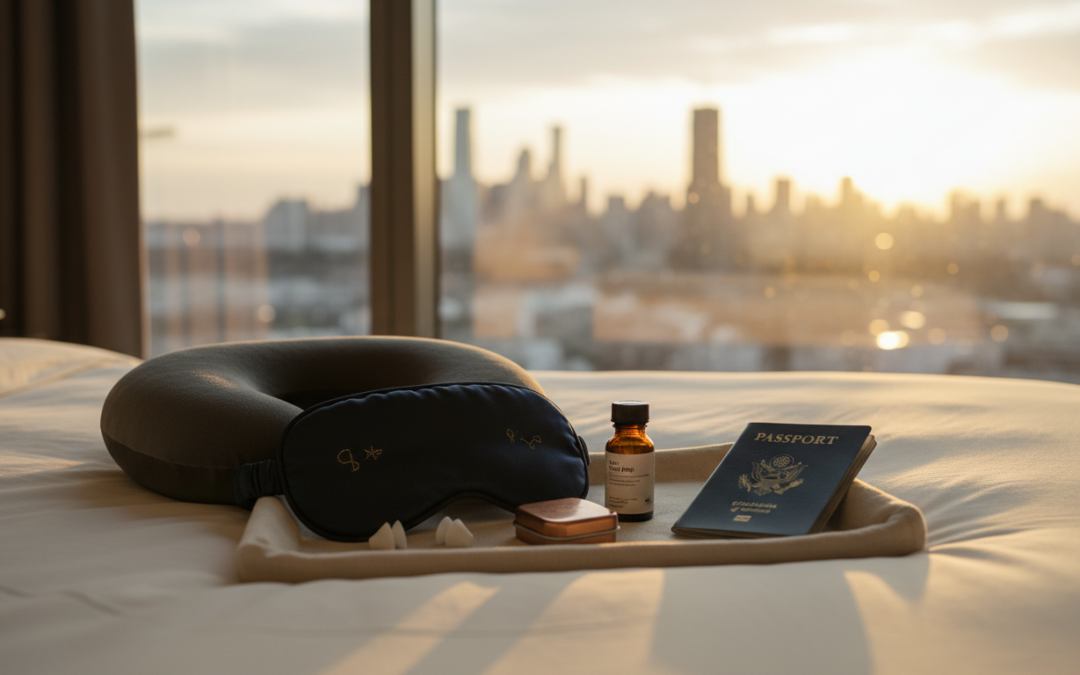
- Sleep mask — Essential for sleeping on the plane and in hotel rooms with light leaks. See our sleep mask picks.
- Earplugs — Block engine noise on planes and hotel noise. See our earplug guide.
- Travel pillow — A good neck pillow makes plane sleep possible. Memory foam or inflatable options pack small.
- Melatonin — Low-dose (0.5–1 mg), for the first few nights at your destination.
- Blue light glasses — Useful for evening flights when you need to wind down. See our blue light glasses guide.
- Portable white noise app — Your phone plus earbuds can create a consistent sleep environment anywhere. See our sleep app roundup.
The Bottom Line
Jet lag is predictable and manageable. Shift your schedule before travel, use light as your primary reset tool, time melatonin carefully, and pack the right gear. You won’t eliminate jet lag entirely, but you can cut recovery time in half.
For more on light timing, see Blue Light and Sleep. For melatonin details, see Melatonin for Sleep.