Best Sleep Apps for Anxiety at Night: What To Look For Before You Download
Quick answer
The best sleep app for anxiety at night is not necessarily the one with the prettiest ocean sounds, the celebrity narrator, or the flashiest subscription screen.
For most people, the better choice is an app that helps with one specific bedtime problem:
- Racing thoughts: guided meditation, cognitive defusion, worry journaling, or CBT-I-style exercises
- Physical tension: progressive muscle relaxation, body scans, paced breathing, gentle wind-down audio
- Noise sensitivity: white noise, brown noise, pink noise, nature sounds, timer controls
- Irregular routine: bedtime reminders, wind-down plans, sleep diary, habit tracking
- Chronic insomnia patterns: evidence-based CBT-I or clinician-guided digital CBT-I tools
Sleep apps may help some people build a calmer pre-sleep routine, but they are not a cure for anxiety, insomnia, sleep apnea, pain, or medication-related sleep problems. If anxiety is persistent, worsening, interfering with daily life, or paired with severe insomnia, panic symptoms, breathing pauses, heavy snoring, or severe daytime sleepiness, it is worth talking with a qualified clinician.
Why anxiety feels louder at night
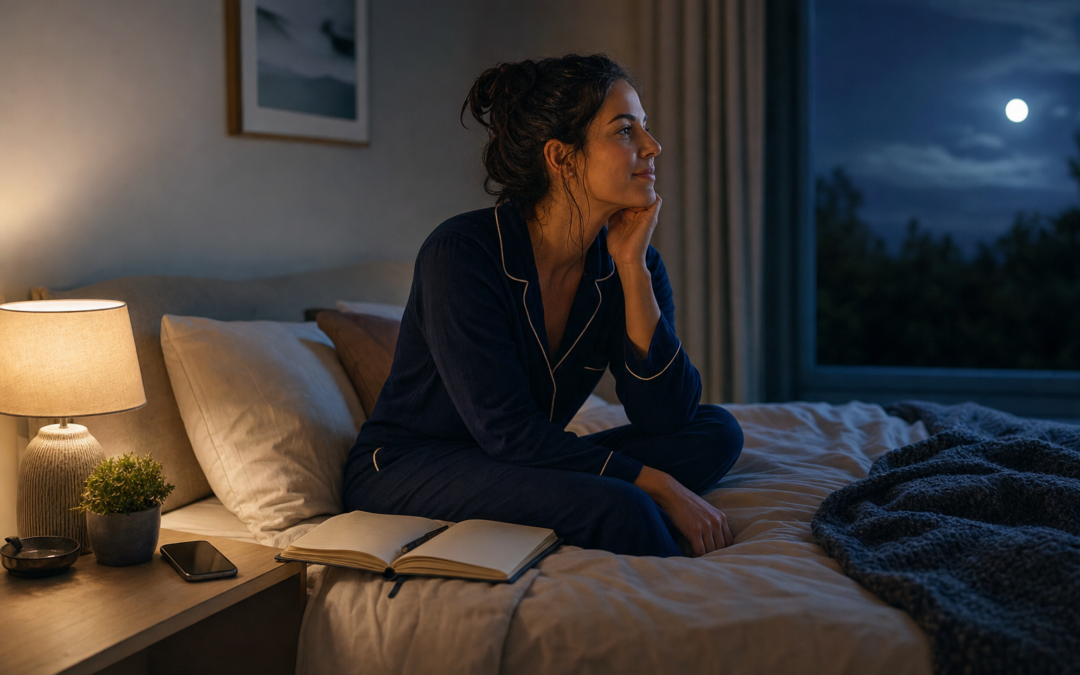
Nighttime anxiety has a very annoying talent: it waits until the house is quiet, the lights are off, and your calendar has no more distractions — then it opens every browser tab in your brain.
That does not mean anything is “wrong” with you. NIMH notes that feeling anxious is a normal part of life, especially around health, money, work, school, and family. Anxiety becomes more concerning when it does not go away, happens across many situations, worsens over time, or interferes with daily functioning.
Bedtime can amplify worry because there is less external input competing for attention. You are not answering messages, driving, working, cooking, or pretending that one more tiny email is “basically done.” You are lying still, in the dark, with a nervous system that may still be highly activated.
A sleep app can be useful if it gives that nervous system a repeatable off-ramp. The key is choosing the right kind of app for the actual problem.
First: decide what you need the app to do
Before downloading anything, answer this:
What keeps you awake most often?
Not in vague terms like “sleep is bad.” Be more specific. Sleep gets easier to troubleshoot when the target is small.
If your mind races
Look for:
- Guided meditations for bedtime
- Cognitive exercises that help you notice thoughts without wrestling them
- Worry journaling prompts
- “Park tomorrow’s problems” routines
- Short sessions under 10–15 minutes
Avoid apps that push endless content browsing at bedtime. If you spend 22 minutes choosing between “Moonlit Scandinavian River” and “Ancient Galactic Flute,” the app has become the problem. Incredible technology. Not helpful at bedtime.
If your body feels tense
Look for:
- Progressive muscle relaxation
- Body scans
- Paced breathing
- Gentle stretching routines
- Audio that does not require staring at the screen
NCBI’s InformedHealth.org summary notes that relaxation methods such as progressive muscle relaxation, breathing exercises, meditation, calming imagery, gentle yoga, tai chi, and music may help some people reduce tension and support sleep.
If noise keeps you alert
Look for:
- White noise, brown noise, pink noise, or nature sounds
- Offline playback
- Fade-out timers
- Volume controls
- No sudden ads or audio interruptions
The last one matters. Nothing says “restorative sleep” like a loud mobile-game ad at 11:47 p.m. Truly elite sabotage.
If your routine is chaotic
Look for:
- Bedtime reminders
- Wind-down checklists
- Sleep diary tools
- Consistent wake-time tracking
- Gentle habit streaks without shame-based notifications
NHLBI recommends consistent sleep and wake times, quiet time before bed, limiting bright screens, avoiding heavy meals and late stimulants, getting daylight, and keeping the bedroom quiet, cool, and dark. An app can support those habits, but it cannot replace them.
If insomnia has become persistent
Look for:
- CBT-I-based education
- Sleep diary tracking
- Stimulus control guidance
- Sleep scheduling tools
- Clinician involvement or clear evidence references
CBT-I stands for cognitive behavioral therapy for insomnia. AASM describes CBT-I as first-line treatment for chronic insomnia in adults, and notes that digital CBT-I may be useful when access to therapist-delivered CBT-I is limited. However, AASM also cautions that product claims can overstate evidence, and that traditional clinician-delivered CBT-I has stronger evidence than many guided or unguided internet programs.
Translation: a serious insomnia app should act more like a structured program and less like a sleepy Spotify playlist with a subscription model.
The main types of sleep apps for nighttime anxiety
1. Meditation and mindfulness apps
These apps are usually best for people whose biggest issue is mental noise: worry loops, planning tomorrow, replaying conversations, or suddenly remembering every mistake since 2009.
Useful features may include:
- Sleep-focused guided meditations
- Body scans
- Acceptance-based exercises
- Short “middle of the night” sessions
- Audio-only mode
- Downloadable tracks
What to watch for:
- Overly long intros
- Content libraries that encourage late-night scrolling
- Strong claims like “eliminate anxiety” or “guaranteed deep sleep”
- High-pressure trials or confusing cancellation terms
A good meditation app may support relaxation. It should not promise to treat an anxiety disorder or cure insomnia.
2. Breathing and nervous-system calming apps
Breathing apps can be useful when anxiety shows up physically: tight chest, tense shoulders, shallow breathing, clenched jaw, or general “my body thinks we are being chased by a lion but it is actually tax paperwork.”
Useful features may include:
- Paced breathing visuals
- Audio cues so you can keep your eyes closed
- Adjustable breathing pace
- Short sessions for nighttime awakenings
- No bright flashing animations
Keep it gentle. If breathwork makes you dizzy, panicky, or uncomfortable, stop and choose another wind-down tool. People with respiratory, cardiovascular, panic, or other medical concerns should ask a clinician what is appropriate.
3. CBT-I-style apps and digital CBT-I programs
CBT-I-style tools are more structured. They are designed around sleep behaviors and thought patterns rather than just relaxation audio.
They may include:
- Sleep diaries
- Sleep efficiency tracking
- Stimulus control guidance
- Sleep scheduling
- Education about unhelpful sleep beliefs
- Relapse prevention planning
AASM’s review of digital CBT-I platforms says evidence-based programs often combine sleep hygiene, sleep restriction, stimulus control, relaxation or mindfulness, cognitive therapy, and relapse prevention over several weeks.
Important caveat: sleep restriction and scheduling guidance can be powerful but should be handled carefully, especially for people with bipolar disorder, seizure disorders, severe depression, pregnancy, safety-sensitive jobs, major sleepiness, or complex medical situations. A clinician-guided option is safer when there are risk factors.
4. Sound apps: white noise, brown noise, pink noise, and nature audio
Sound apps are a good fit when the issue is external noise or silence that feels too loud.
Look for:
- Stable sounds without sudden changes
- Timer and fade-out controls
- Offline use
- Custom mixes only if they do not create choice overload
- Low-volume listening options
Keep volume reasonable. Sound should mask distractions, not bully your ears into submission. If you have ear pain, ringing, hearing changes, or sensitivity, check with a clinician.
Internal link opportunity: link here to FSF’s draft/published post on White Noise vs Brown Noise vs Pink Noise for Sleep.
5. Sleep story and bedtime audio apps
Sleep stories can help some people redirect attention away from worry. The best ones are intentionally low-stakes: pleasant, slow, and boring enough that you do not care how they end.
That is a feature, not a bug. If the plot has explosions, betrayals, or a season finale energy, it is not a sleep story. It is Netflix with pajamas.
Look for:
- Calm narration
- Adjustable playback speed
- Fade-out timers
- Minimal ads
- No cliffhangers
6. Sleep tracking apps
Tracking can be useful if it helps you notice patterns. It can backfire if it makes you obsess over every score.
Look for:
- Simple trend views
- Sleep diary notes
- Ability to hide scores if they stress you out
- Clear explanation of what is estimated vs. measured
- Privacy controls
Sleep tracking apps usually estimate sleep from movement, sound, phone use, or wearable data. Treat the numbers as clues, not courtroom evidence.
Internal link opportunity: link here to FSF’s existing Sleep Trackers Compared post and future Sleep Tracker Metrics That Actually Matter article.
What to look for in a sleep app for anxiety
1. A clear use case
The app should solve one bedtime job. Examples:
- “Help me do a 10-minute wind-down.”
- “Give me a guided body scan when I wake at 2 a.m.”
- “Mask apartment noise.”
- “Track sleep habits without making me neurotic.”
If the app tries to be therapy, a podcast platform, a tracker, a social network, a horoscope, and a dolphin-sound casino, proceed carefully.
2. Evidence-aware language
Green flags:
- “May help”
- “Supports relaxation”
- “Designed to help build a routine”
- Clear explanation of methods used
- References to CBT-I, mindfulness, or sleep hygiene without overpromising
Red flags:
- “Cures insomnia”
- “Stops anxiety permanently”
- “Guaranteed sleep in minutes”
- “Doctor-approved” with no details
- Fake countdown timers or pressure tactics
Results vary. That is not weak copy; that is reality wearing a helmet.
3. Low-friction bedtime mode
A sleep app should not require a login puzzle, five popups, three upgrades, and a motivational badge before it lets you relax.
Look for:
- Dark mode
- Audio-only navigation
- Favorites or quick-start button
- Offline downloads
- No autoplay surprises
- No bright animations at bedtime
4. Privacy and data controls
This matters more than most people think. Sleep and anxiety data can be personal.
Before using an app heavily, check:
- What data it collects
- Whether it shares data with third parties
- Whether it connects with wearables or health records
- How to delete your data
- Whether location, microphone, or health permissions are actually necessary
AASM specifically notes that clinicians should consider data access, security, privacy policies, cost, and workflow integration when evaluating digital CBT-I tools. Consumers should be just as nosy. Privacy settings are not glamorous, but neither is handing your 3 a.m. panic notes to an ad ecosystem.
5. A realistic price
Paid apps can be worth it if they help you use fewer scattered tools and build a repeatable routine. But a subscription is not automatically better than a free timer, a notes app, and one good breathing exercise.
Ask:
- Will I use this at least 3–4 nights per week?
- Does it replace something else I already pay for?
- Can I cancel easily?
- Does the free version solve enough?
- Is there a one-time purchase option?
6. Clinician escalation language
A trustworthy sleep app should not pretend it replaces medical care.
Talk with a clinician if you have:
- Insomnia that persists for weeks or affects daytime function
- Severe daytime sleepiness
- Loud snoring, choking/gasping, or breathing pauses during sleep
- Morning headaches with snoring or suspected sleep apnea
- Anxiety that is worsening or interfering with work, relationships, or daily life
- Panic symptoms, depression symptoms, or thoughts of self-harm
- Pain that disrupts sleep
- Medication, supplement, alcohol, or substance-use questions
If you are in the U.S. and having thoughts of suicide or self-harm, call or text 988 for the Suicide & Crisis Lifeline. In an immediate emergency, call emergency services.
A simple 7-night app test
Do not judge a sleep app after one heroic night. Test it like a tiny experiment.
Night 1: Pick one target
Choose one goal:
- Calm racing thoughts
- Relax the body
- Mask noise
- Build a routine
- Track patterns
One goal. Not seven. We are optimizing sleep, not building an overcomplicated control center.
Nights 2–3: Use the same feature
Use the same meditation, breathing session, sound, or CBT-I exercise for two nights. The goal is repetition, not novelty.
Nights 4–5: Adjust the timing
Try starting earlier in your wind-down window. Many people wait until they are already frustrated, then expect an app to perform emergency magic. Better: use it before the bedtime spiral gets traction.
Night 6: Check friction
Ask:
- Did opening the app feel easy?
- Did it make me look at the screen too much?
- Did it calm me or make me browse?
- Did notifications help or annoy me?
Night 7: Keep, change, or delete
Keep it if it supports your routine. Change the feature if the app is useful but not quite right. Delete it if it adds friction, pressure, or obsession.
The best sleep app is the one you can use consistently without turning bedtime into a performance review.
Example app-matching guide
| Nighttime problem | App feature to try | Avoid |
|---|---|---|
| Racing thoughts | Guided meditation, worry journal, CBT-I-style thought exercises | Huge content libraries that trigger scrolling |
| Physical tension | Progressive muscle relaxation, body scan, paced breathing | Intense breathwork that feels uncomfortable |
| Neighbor/street noise | White/brown/pink noise, nature sounds, timer | Sudden ads, high volume, looping glitches |
| Waking at 2–3 a.m. | Short “back to sleep” audio, low-light mode | Bright screens, checking sleep scores |
| Irregular routine | Bedtime reminders, wind-down checklist, sleep diary | Shame-based streaks or noisy notifications |
| Chronic insomnia | Evidence-based CBT-I or clinician-guided dCBT-I | Apps promising cures or skipping safety caveats |
What not to expect from sleep apps
A sleep app should not be expected to:
- Cure an anxiety disorder
- Treat sleep apnea
- Replace CBT-I with a trained clinician
- Override caffeine, alcohol, stress, pain, or inconsistent sleep schedules
- Diagnose medical conditions
- Guarantee sleep on demand
Apps are support tools. Useful? Sometimes. Magic? No. If anyone has invented guaranteed sleep magic, they are suspiciously quiet about it and probably charging $19.99/month.
Where sleep apps fit into a better nighttime routine
Use the app as one piece of a routine:
- Set a consistent wake time. This anchors the body clock.
- Dim lights and reduce bright screens before bed. NHLBI recommends quiet time and avoiding bright artificial light from screens in the hour before bed.
- Do a quick worry download. Write tomorrow’s tasks on paper or in a notes app before you get into bed.
- Start the app before you are desperate. Use breathing, meditation, sound, or a body scan as part of wind-down.
- Keep the bedroom boring. Cool, dark, quiet, and not a command center.
- If you cannot sleep, reduce the battle. Stimulus control approaches often recommend getting out of bed when you are unable to sleep and returning when sleepy, rather than training your brain that bed equals frustration.
Internal link opportunity: link to FSF’s Sleep Maintenance Insomnia article for readers who fall asleep but wake during the night, and Why Do I Wake Up at 3 AM Every Night? for recurring early-morning wakeups.
Bottom line
The best sleep apps for anxiety at night are the ones that make bedtime simpler, not busier.
Choose based on the problem you actually have:
- Racing thoughts → meditation, worry tools, CBT-I-style exercises
- Tension → body scans, progressive muscle relaxation, paced breathing
- Noise → steady sound masking with safe volume and timers
- Chaotic routine → reminders, diaries, and simple wind-down checklists
- Persistent insomnia → evidence-based CBT-I support, ideally with clinician guidance when needed
Use soft expectations: a good app may help you relax, build a routine, or reduce bedtime friction. Results vary. And if sleep problems or anxiety are persistent, severe, or paired with concerning symptoms, get professional input instead of trying to out-drive the problem alone.
- National Institute of Mental Health. Anxiety Disorders. Last reviewed December 2024.
https://www.nimh.nih.gov/health/topics/anxiety-disorders
- National Heart, Lung, and Blood Institute / NIH. Sleep Deprivation and Deficiency: Healthy Sleep Habits. Last updated March 24, 2022.
https://www.nhlbi.nih.gov/health/sleep-deprivation/healthy-sleep-habits
- American Academy of Sleep Medicine. Digital Cognitive Behavioral Therapy for Insomnia: Platforms and Characteristics. Published March 6, 2024.
- InformedHealth.org / NCBI Bookshelf. Sleep disorders and problems (insomnia): What can you do if you have trouble sleeping? Last updated July 31, 2024.
https://www.ncbi.nlm.nih.gov/books/NBK279320/
- CDC. About Sleep.
https://www.cdc.gov/sleep/about/index.html
Disclosure
Fast Sleep Fix may earn a commission if affiliate links are added to this article in the future. This version was published without active affiliate links.